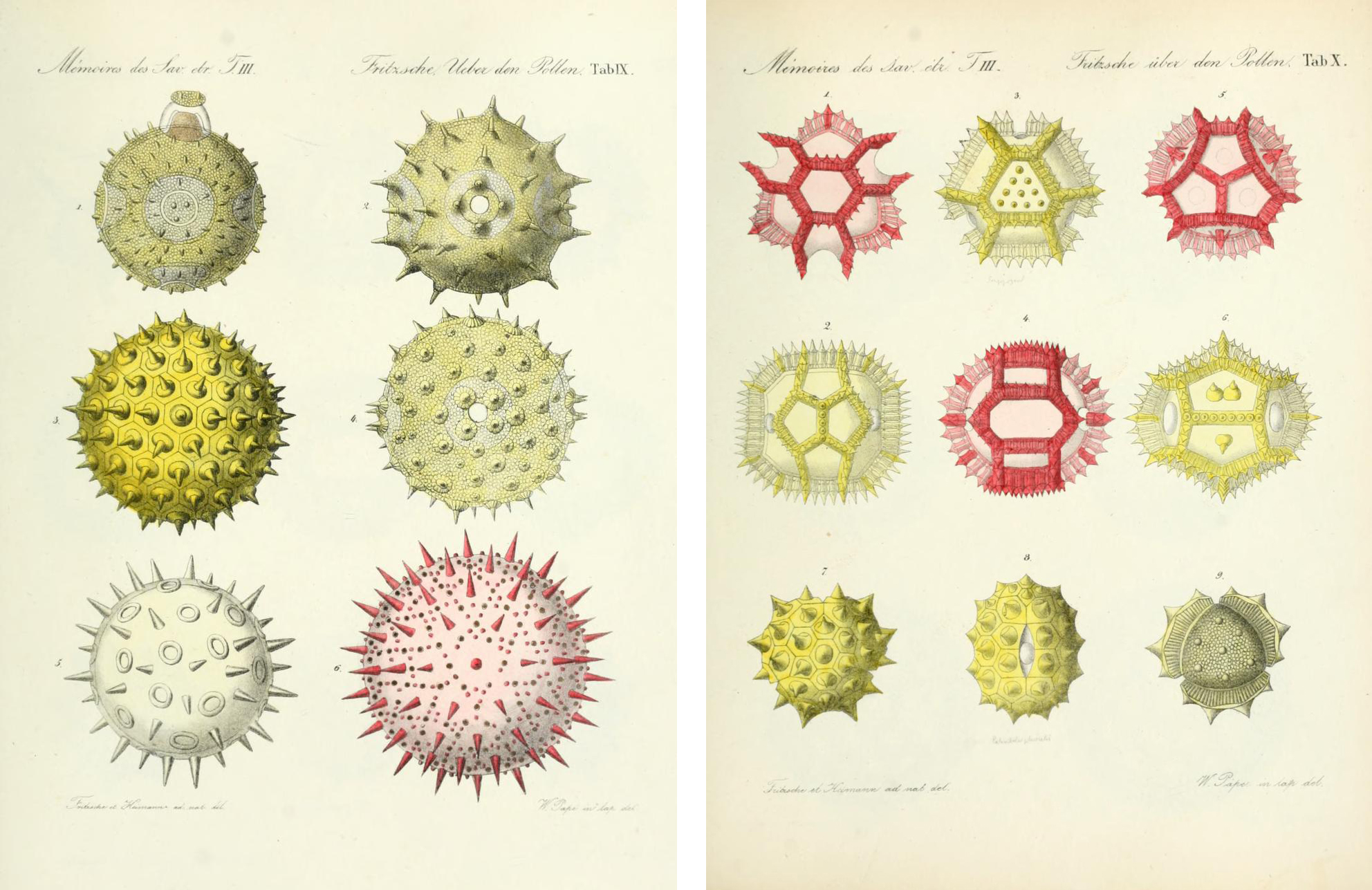
This text is a small meandering journey with, initially, an uncertain destination. It begins with an observation, in the form of a comparison between two distinct forms of visual representation. One is a set of 19th century scientific illustrations, specifically those of Ernst Haeckel and Carl Julius Fritzsche. The other is the proliferation of graphic representations of the Covid virus – the little spiked ball that has invaded our screens and been centre stage in TV newsroom backdrops across the world.
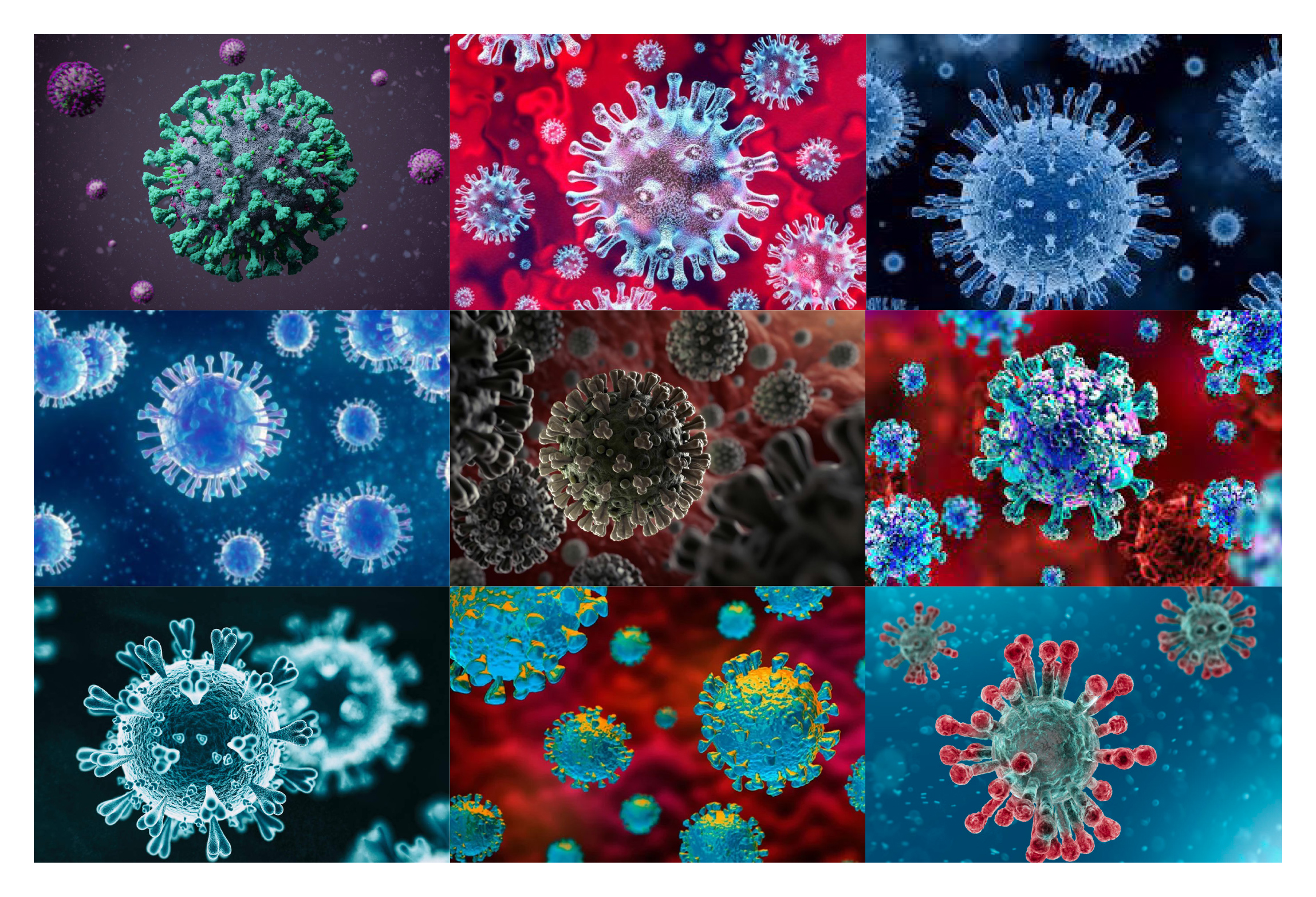
“Right now, the image that everyone sees is essentially being treated like a brand,” says Deb Gumucio, founder of the BioArtography Project at the University of Michigan, and professor emerita of cell and developmental biology. The project she founded was a response, as a scientist, to the beauty she believes is revealed in molecular photography. The Covid image she says “looks a little like some sort of menacing alien machine”, and she suggests that although a lot of people have seen this image, it doesn’t give them a lot of useful information about the virus. She believes the omnipresent cellular image could and should be used as an educational tool to help us understand how the virus functions and that she would like to see more captions and more people talking about what the image can actually tell us. Whether it’s used as a visual tool or as a brand, whether it appears as menacing or as any number of its cute or fluffy versions, there’s little doubt that, rather like the virus itself, it has invaded our lives and become part of our visual lexicon.
From a different direction, as an educator, I recently alerted my students to the 19th century illustrations of two German scientists, the zoologist (and naturalist, eugenicist, philosopher, physician, professor, marine biologist, and artist) Ernst Haeckel, and the pharmacist and chemist, Carl Julius Fritzsche. I did so as part of a general drive to encourage visual research, and also, in this case, to direct their attention to the extraordinary beauty and skill of these illustrations, not unlike much 19th century scientific illustration.
With the Covid virus images in mind I was struck by the similarity – and the difference – to Carl Julius Fritzsche’s illustrations of various strains of pollen in extreme magnification in Ueber den Pollen, (1837).
Then as further comparison there is the far more extensive work of Ernst Haeckel. Die Radiolarien (1862) is a two-volume monograph dedicated to the single-celled aquatic animals or protozoa with their spherical amoeba-like bodies and radiating, elaborate, spiny skeletons of silica, once again reminiscent of the Covid representation. Haeckel’s quite glorious illustrations in Kunstformen der Natur (published between 1899 and 1904) further explore the beauty of natural forms presenting, in exquisite compositions, a vision of what we normally cannot see.
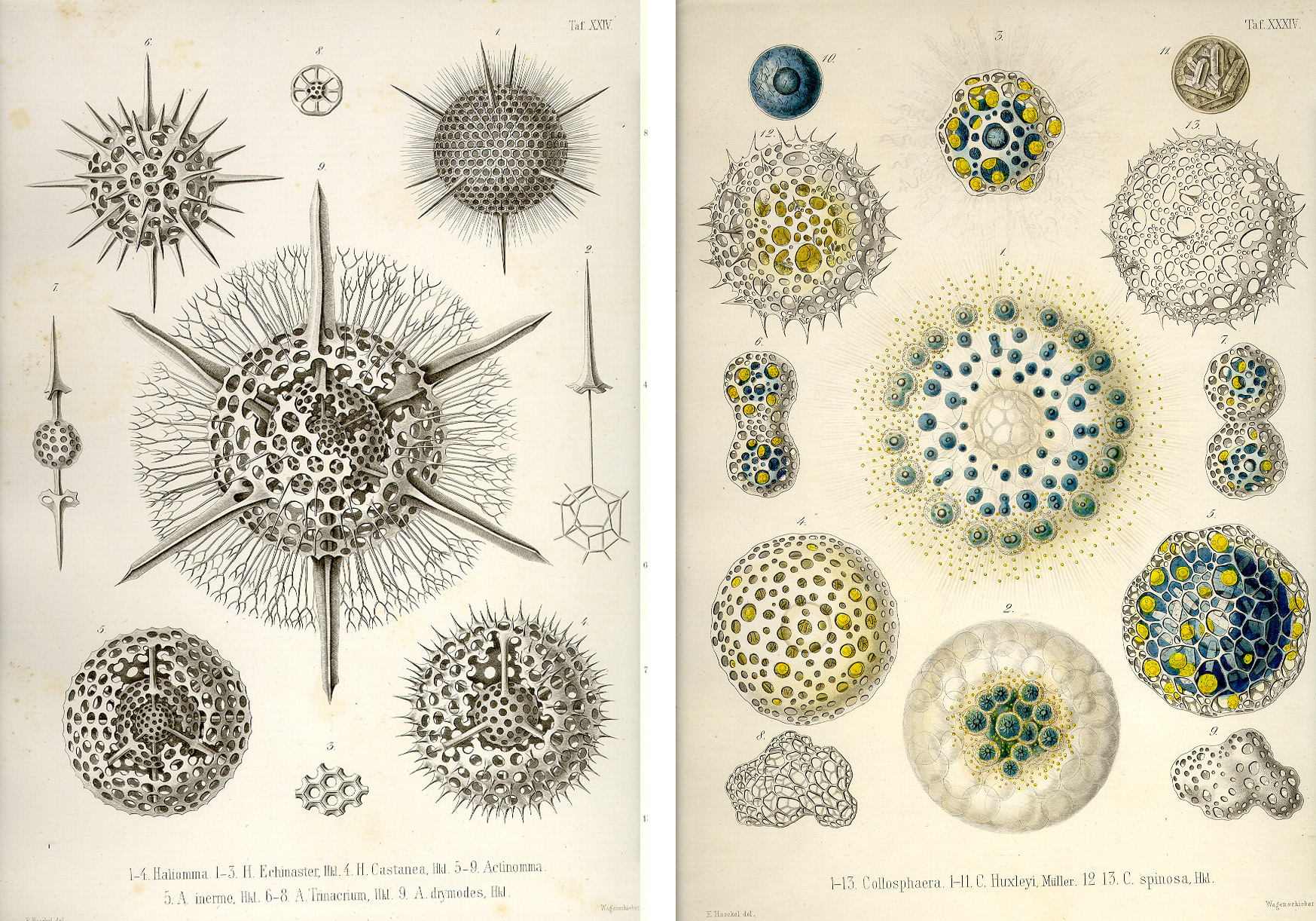
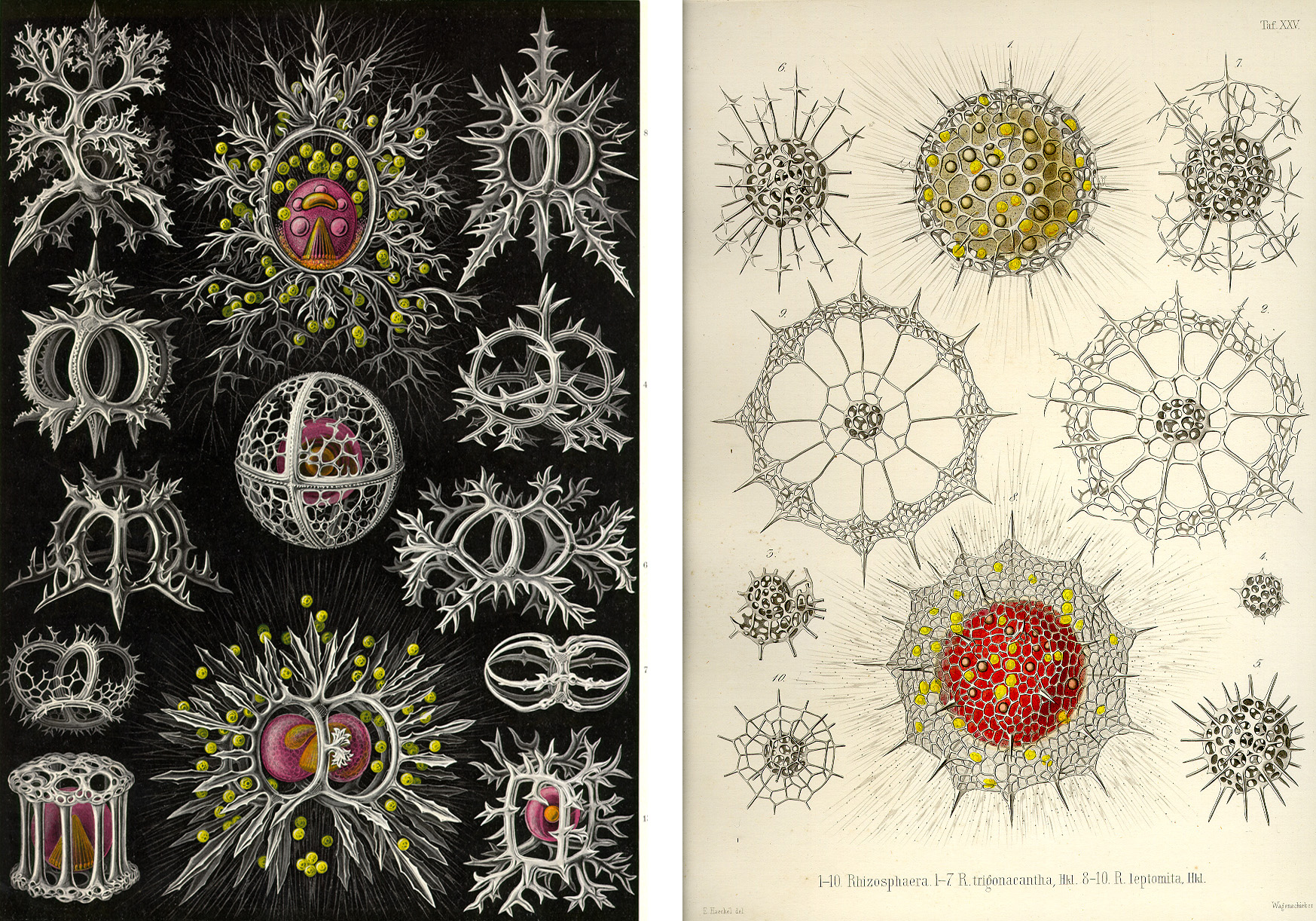
The link that interests me in particular, between the Covid representations and the illustrations, isn’t so much the subject matter – whether its pollen or a virus or any other organism – although they share clear visual characteristics. Nor is it especially to do with concepts of beauty, although this is also a subject worthy of exploration. What caught my attention has to do with perspective – attempting to examine things outside of our normal range of vision. That said, it would be worth discussing the manner in which the microscopic world in these images is illustrated – from the hand-made drawings of Fritzsche and Haeckel, to the photographic and computer generated images of the Covid virus. How much, keeping in mind the comments of Deb Gumucio, does the manner of the rendering circumscribe out response and interaction?
Moving back to perspective, in holding a flower in our hands we are able to see its petals and we are able to detect the pollen on the stamen, but we can’t see the pollen in any detail and consequently can’t say anything about its structure – not without the help of tools. The same is true of looking at the stars in the night sky. In other words, there is ‘normal’ vision (what we can see with the naked eye), and there is enhanced vision – which uses tools such as microscopes and telescopes. It’s a question of scale.
Speaking of which, the short film, Powers of Ten by Charles and Ray Eames, released in 1977 (from a sketch version made in 1968), is precisely an exploration of scale. The film uses the system of exponential powers to visualise the importance of scale, beginning with an overhead view of a man and woman picnicking in a park, the film first expands out from the Earth until the entire universe is surveyed, then reduces inward until a single atom and its quarks are observed.
Charles and Ray Eames’s grandson, Eames Demetrios has suggested that scale is the new geography. In asking what scale deals with he says that most people reply that it is about the size of everything. He counters by qualifying the answer – that it is about the relative size of things.
The illustrations mentioned above, and the Powers of Ten film in particular, don’t simply address vision as a physical sensory ability, they move us into the realm of vision as perception. The perception that what you can see is not all that exists and that the understanding of scale is a way of situating ourselves in the scheme of things.
As an aside, I recall once, when feeling sorry for myself for some reason or other, a friend showing me a map of the world and then asking whether I could see myself on it. It was an honest although blunt intercession but I understood the point that in focusing on oneself it’s easy to loose a sense of scale.
The toll of the global pandemic in every sense has yet to be measured. In addition to the many lives it has taken, it has rearranged the way we interact, stalled and derailed many plans and inverted many outlooks. The task of combatting any collateral feelings of isolation or dislocation surely means building bridges, not islands. And surely this is the time to renew faith in each other, learning to trust and to rely on others rather than in ourselves alone. As a consequence, my counsel to my students is not too different from before, probably reinforced in fact – to cooperate, to search for connections, to look for active collaborations, and to build partnerships. There is after all, no future that is not a collective one.
In the end this small journey, despite the meandering – or perhaps because of it – is about what the title says its about. That there are things we habitually look at and there are things beyond our immediate vision that require enhanced looking, but not necessarily using our eyesight alone. Things that make up the systems into which we are embedded, but can’t detect from a single viewpoint. If design is, as I believe, an inherently analytical process that allows us to pull things apart, examine them, and reassemble them, hopefully in new, enlightening and critical ways, then it should be a very useful tool indeed in extending and expanding our vision beyond the immediate and the familiar. At which point begins another journey.
Postscipt
The representations (Covid and the 19th century illustrations) and the Powers of Ten film, are triggers to talk about looking from a perspective which is not a familiar one. One that has a different scale. And whilst introspection can sometimes be useful, displacing oneself from the centre of things, whcih involves the shifting of scale and perspective, can create greater opportunity identifying patterns and systems, and commonality.
Looking however and what you think you’ve discovered is subject to debate. As it always has been. We won’t see the same. Nothing new there. It’s up to each to show what they see and for others to counter. But look in detail at least – broader, wider, closer. What matters I would argue is that everyone who wants to has the opportunity to look. And that looking requires depth, rigour, and dedication.
Regarding Haeckel, I am aware of his history and his support of the discredited theory of Eugenics (and that the Nazis tried to claim him at one point but ultimately rejected him). How his beliefs affect how we assess his botanical illustrations is a different but interesting discussion.